

Technical articles
What are the functions and benefits of the ABB-compatible control system models PPD113 PPD103B01 3BHE020455R0001 3BHE023784R2630 AC 800PEC? What value can they bring to a factory?
Date: Jan 27, 2026 Views: 5903
ABB AC 800PEC Control System: Matching Models, Functions, and Factory Value Analysis
I. Matching Models and Relevance
Core Matching Models
PPD113 3BHE023784R2630 / PPD103B01 3BHE020455R0001 3BHE023784R2630: Belongs to ABB static excitation devices (such as the PPD100 series), used in conjunction with the AC 800PEC for generator excitation control. It supports high-precision current regulation, fast response, and multiple protection functions (overvoltage/overcurrent/undervoltage protection). It is compatible with the AC 800F Freelance control system and meets the integration requirements of the AC 800PEC.
.jpg)
As a key module of the AC 800PEC system, it is used for high-performance control units, I/O modules, and fiber optic communication links. It supports 100-microsecond-level fast control cycles and is suitable for high-dynamic industrial scenarios such as aluminum rolling mills and electric arc furnaces.
Other related modules, such as ABB AC 800PEC PC D230 3BHE022291R0101 PC D230 A101, constitute the modular hardware architecture of AC 800PEC, supporting distributed I/O, redundant communication, and FPGA acceleration.
System Integration Characteristics
AC 800PEC interconnects with supporting modules via fiber optic links (such as PEC-PEC communication), supports IEC61131-3 standard programming, MATLAB/Simulink model-driven development, and deep integration with the ABB Ability™ 800xA system, enabling plant-wide data collaboration and intelligent optimization.
II. Core Functions and Technical Advantages
High-Performance Control Capabilities
Ultra-short control cycle: as low as 100 microseconds, meeting the millisecond-level response requirements of aluminum rolling mills and electric arc furnaces, ensuring process stability (e.g., aluminum strip thickness control accuracy of ±0.1%).
Multi-level processing architecture: Divided into industrial-grade (IEC61131-3), fast control level (Simulink), and high-speed control level (FPGA), adapting to complex tasks ranging from slow monitoring to nanosecond-level hardware logic.
High reliability design: Industrial-grade hardware (no moving parts), redundant communication links, and a power-loss protected file system ensure continuous operation (MTBF > 100,000 hours).
Industry-customized functions:
Power electronic control: Supports high-power rectifiers, synchronous generator excitation, and IGCT/IGBT drives, optimizing energy efficiency (reducing energy consumption by 5-15%).
Process optimization algorithms: Such as aluminum rolling mill load fluctuation detection, electric arc furnace adaptive electrode control, and load shedding protection, improving output and quality (e.g., aluminum foil thickness deviation ≤1%).
Predictive maintenance: Integrated vibration/temperature monitoring and remaining life prediction reduce unplanned downtime (reducing maintenance costs by 20-30%).
III. Factory Value Creation Path
Economic Efficiency Improvement
Cost Reduction and Efficiency Enhancement:Reduce raw material waste through precise control (e.g., increasing aluminum yield by 3-5%), shorten development cycles (reducing engineering time by 30%), and lower labor and resource costs.
Return on Assets (ROA):Optimize equipment utilization and extend the lifespan of key components (e.g., extending the excitation module lifespan to 15 years), increasing ROA by 10-20%.
Energy Consumption Optimization: Adopt high-efficiency rectification technology and dynamic voltage regulation to reduce overall factory energy consumption by 5-10%, aligning with green manufacturing trends.
Process Quality and Reliability
Product Quality: Reduce defect rates through high-precision control (e.g., reducing aluminum strip surface defects by 40%), improving product consistency and meeting the demands of the high-end market.
.jpg)
System Reliability: Redundant design, rapid fault isolation (≤100ms), and remote diagnostic capabilities ensure continuous production and reduce downtime losses.
Scalability and Flexibility: The modular architecture supports on-demand expansion (such as adding I/O modules), adapting to all scenarios from small stand-alone equipment to large production lines.
Industry Application Cases
Aluminum Processing: In a single-stand 6-roll aluminum rolling mill, the AC 800PEC achieves high-speed rolling at 1500m/min, with thickness control accuracy of ±0.1%, increasing output by 15%.
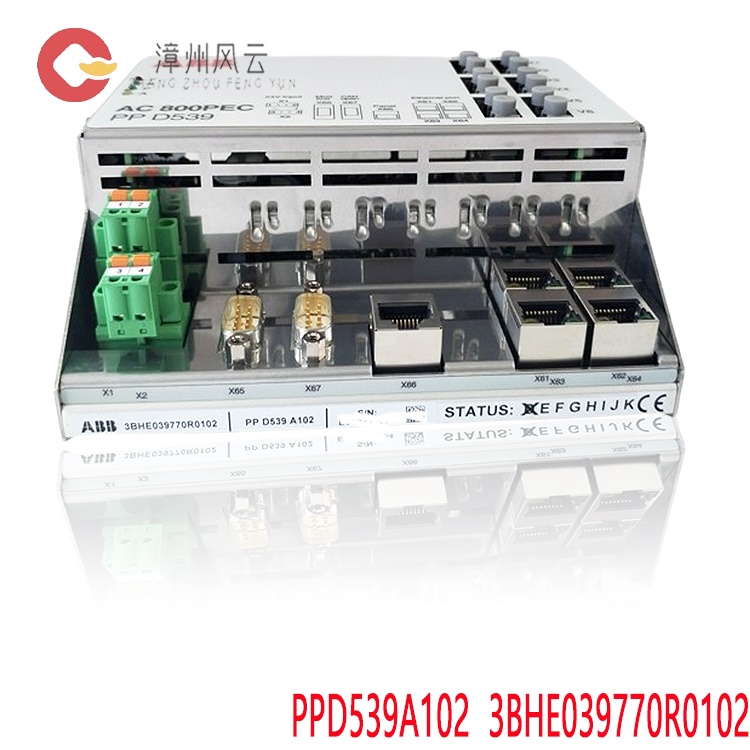
Power Industry: Used for generator excitation control, stabilizing voltage fluctuations (within ±1%) and supporting rapid grid response requirements.
Metallurgy and Shipbuilding: In electric arc furnaces and ship propulsion systems, it optimizes energy recovery and dynamic load matching, reducing operating costs.
Smart Manufacturing: In industrial automated production lines, the 3BHE020455R0001 communication controller supports multi-device data interaction, enabling real-time optimization and scheduling of the production process.
Chemical Industry: The ABB 800xA DCS integrates the PPD113 module, using PID algorithms to control reactor temperature/flow, achieving precise process control and reducing scrap rates.
Conclusion: Through deep integration with PPD113, PPD103B01, 3BHE020455R0001, 3BHE023784R2630, and the 3BHE series modules, combined with its high-performance control algorithms, modular architecture, and industry-customized functions, the AC 800PEC creates significant value for factories—improving production efficiency, reducing energy consumption, enhancing product competitiveness, and driving industrial intelligent transformation. Its technical characteristics and industry adaptability make it a key control platform in fields such as power electronics, metallurgy, and manufacturing.
Recommended related products:
ABB 3BSE050199R1 PM866K02
ABB 3BSE018164R1 PM864AK02
3BHB005243R0106 ABB
ABB 3BHE025541R0101 PCD231B101
3BHE023784R2630 PPD113 B01-26-111001
ABB | 3BHE017628R0002 PPD115A02
3BHE014135R2011 UAD149
3BHE014135R0011 UAD149A0011
3BHE014135R2511 UAD149A02-5-11
3BSE053242R1 PM891K02
3BSE053241R1 PM891K01
3BSE018160R1 PM865K02
3BSE018105R1 PM861K01
3BSE076359R1 PM866A
3BSE053240R1 PM891
3BDH000002R1 PM802F
3BDH000032R1 PM803F
3BSE010798R1 PM820-2
3BSE010800R1 PM825-1
3BSE018105R1 PM861K01
3BSE018161R2 PM864AK01-eA
3BSE030193R1 PM865
PM864AK01 3BSE01816R1
3BSE031151R1 PM865K01
PM866-2 3BSE050201R1
3BSE076355R1 PM867K01
3BSE081638R1 PM867K02
PM866K01 3BSE050198R1
PM864AK01-eA 3BSE018161R2
PM825-1 3BSE010800R1
PM861AK01 3BSE018157R1
PM864AK01 3BSE018161R1
PM866K01 3BSE050198R1
PM865K01 3BSE031151R1
PM866 3BSE050200R1
PM803F 3BDH000530R1
PM825 3BSE010796R1
More......
Address
Room 205, Office Building, No.1 Chaoyang North Road, Longwen District, Zhangzhou City, Fujian Province
fengyunfadacai@qq.com
Sales consultant
Miss.Green
+86 15860249102