.jpg)
.jpg)
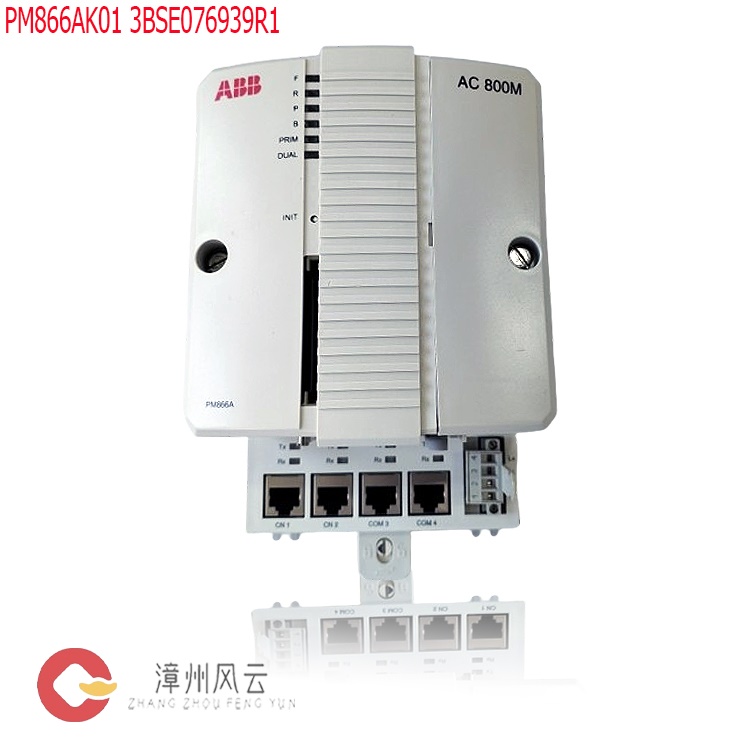
Used for data synchronization between redundant controllers, the unit features two independent onboard Ethernet ports. It connects to the control network via the ABB RNRP (Redundant Network Routing Protocol) to facilitate data exchange with engineering stations, operator stations, and higher-level systems. It supports control network protocols such as MMS and IAC, and provides redundancy for the CPU, CEX-Bus expansion bus, and Ethernet network. The primary and backup controllers synchronize operational data in real time via an RCU-Link, ensuring bumpless failover. With the two Ethernet ports configured as independent networks, the RNRP protocol enables rapid detection of link failures and automatic switching to a backup channel; this eliminates single points of failure, making the system well-suited for continuous industrial processes where unplanned downtime is not an option.
The company has been operating in the field of industrial automation components since 2002.
We primarily supply automation components to heavy industry manufacturers worldwide.
We maintain a globally integrated inventory system, with 22 regional warehouses across 8 countries, ensuring rapid delivery.
Inventory exceeding 100,000+ items.
I. Operating Principle
The PM867K01 3BSE076355R1 is equipped with an MPC866 processor (133 MHz) and 64 MB of RAM. It runs an ABB industrial real-time operating system and executes control tasks in compliance with the IEC 61131-3 international programming standard.
The module is mounted on a TP830 base and connects to S800 I/O modules via the ModuleBus. It utilizes the CEX-Bus for communication module expansion and the RCU-Link for data synchronization between redundant controllers. It features dual independent onboard Ethernet ports, connecting to the control network via the ABB RNRP (Redundant Network Routing Protocol). This enables data exchange with engineering stations, operator stations, and higher-level systems, supporting control network protocols such as MMS and IAC.
During operation, the controller executes tasks cyclically based on preset cycles and priorities: it acquires analog and digital field signals, performs PID closed-loop regulation, sequential control logic, and interlocking operations, and issues control commands to field actuators. For safety-critical functions, the PM867K01 3BSE076355R1 works in conjunction with an SM812 safety monitoring unit to form a 1oo2D (one-out-of-two with diagnostics) voting architecture. It continuously performs self-diagnostics on hardware, software, and communication links, meeting SIL3 safety requirements.
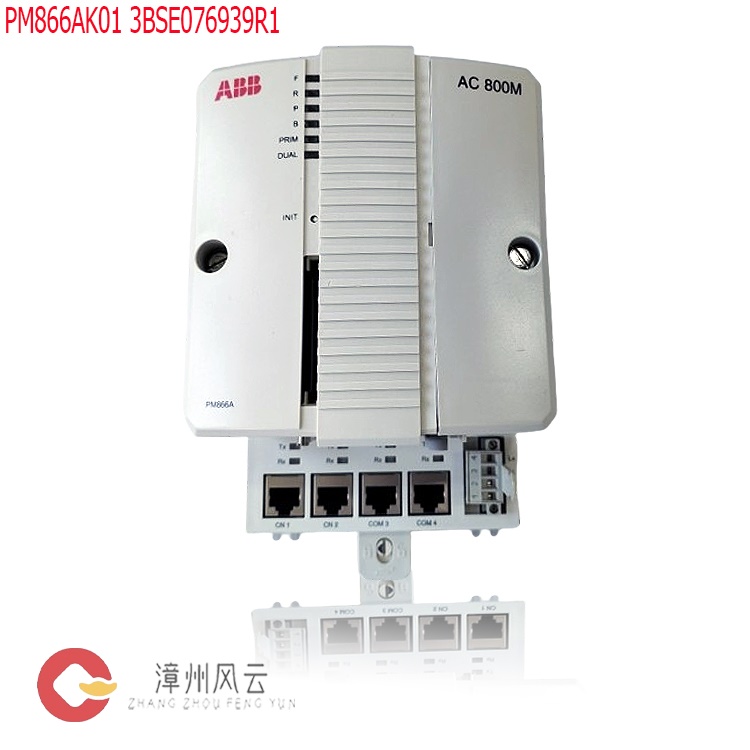
The unit supports CPU redundancy with "hot-standby" capability; in the event of a primary controller failure, the backup controller—having synchronized data via the RCU-Link—ensures a bumpless (seamless) switchover. Programs and project files are stored on a CF (CompactFlash) memory card, and an onboard backup battery ensures that critical parameters in the RAM are retained during power outages. Control engineering tasks—including configuration, simulation, downloading, and online commissioning—are performed using Compact Control Builder (or Control Builder Safe for safety-related programs). Task cycle times are configurable, meeting the millisecond-level control requirements of the process industry.
II. Core Product Advantages
Integration of safety and standard process control (SIL3-compliant): The PM867K01 3BSE076355R1 high-integrity (HI) controller, when paired with the SM812 module, achieves TÜV IEC61508 SIL3 certification. Standard process control logic and SIL-rated safety interlock programs can run concurrently on the same hardware platform. This eliminates the need for a separate safety PLC, saving cabinet space and reducing costs related to hardware, installation, and ongoing maintenance.
Full-loop redundant architecture for high availability and fault tolerance: The system supports CPU redundancy, CEX-Bus expansion bus redundancy, and dual-Ethernet network redundancy. Primary and backup controllers synchronize operational data in real-time via an RCU-Link, ensuring bumpless failover. Dual network ports operate on independent networks, with the RNRP protocol enabling rapid detection of link failures and automatic switching to backup channels. This eliminates single points of failure, making the system ideal for continuous chemical processes where unplanned downtime is not an option.
Stable computational performance with a standard industrial algorithm library: Equipped with a 133MHz MPC866 processor and 64MB of memory, the controller supports multi-priority, time-sliced task scheduling. It includes built-in standard libraries for PID auto-tuning, sequential control, motor and valve function blocks, and batch control. The system supports all five IEC 61131-3 programming languages (with safety-related programs restricted to FBD, ST, and SFC) and allows for the development of custom function blocks to meet complex process control requirements. Modular and open communication with flexible expansion: Features a modular, DIN-rail mountable design, with a CEX-Bus that allows for the addition of various communication modules. It supports Ethernet-based MMS and IAC protocols; with the use of dedicated communication cards, it can interface with third-party protocols—such as Modbus TCP and Profibus DP—to connect with variable frequency drives (VFDs), intelligent instruments, and SCADA systems. It is natively compatible with S800 High Integrity I/O, supporting a hybrid deployment of local and remote I/O, and allowing for scalable system expansion.
Industrial-grade hardware designed for harsh field environments: Utilizes a fanless, sealed enclosure that is resistant to vibration, dust, and electromagnetic interference. Supports online hot-swapping of controllers (within a redundant architecture), minimizing downtime for maintenance. Integrated front-panel status indicators (POWER, RUN, FAULT, INIT) provide clear, intuitive diagnostics, reducing the time required to locate and troubleshoot faults.

Unified engineering platform to reduce total lifecycle costs: Powered by the Compact Control Builder / Control Builder Safe engineering software, it supports offline simulation, online program monitoring, and project backup/restore. Control program libraries are reusable, simplifying project configuration, future retrofits, and system expansion. Safety-related programs are managed independently, ensuring compliance with safety-critical change management processes.
III. Applicable Industries and Functions
1. Petrochemical Industry
Function: Used in oil refining, ethylene production, oil and gas gathering and transportation, and fine chemical reaction units to perform PID control for temperature, pressure, level, and flow. When paired with the SM812 module, it enables the implementation of SIL3-rated Emergency Shutdown (ESD) interlock systems, mitigating risks of leaks or explosions and ensuring long-term, safe, and continuous plant operation.
2. Power and Energy Industry (Thermal Power, Hydropower, Biomass Power, and Substation Auxiliary Control)
Function: Provides sequential control and parameter regulation for boilers, steam turbines, and their auxiliary equipment, as well as safety trip interlocks for generator units. The SIL3-compliant architecture meets standards for boiler furnace protection and auxiliary equipment safety interlocks, enhancing both the automation level and safety protection standards of power plants. 3. Water Treatment and Solid Waste Environmental Protection Industry
Application: Used in municipal water supply, wastewater treatment plants, waste-to-energy (incineration) plants, and desulfurization/denitrification projects. It enables sequential control of pumps and valves, closed-loop regulation of water quality parameters, and safety protection for incinerators—ensuring stable effluent quality and compliance with discharge standards for flue gas and wastewater.
4. Metallurgy and Mining Industry
Application: Facilitates process regulation and equipment interlocking/protection for blast furnaces, sintering plants, steel rolling mills, and mineral processing lines. Its redundant architecture is designed for harsh industrial environments—characterized by high temperatures, heavy dust, and strong electromagnetic interference—thereby minimizing production losses caused by unplanned downtime.
5. Pharmaceutical and Fine Chemical Industry
Application: Supports control of batch-based reaction processes, management of temperature, humidity, and pressure in cleanrooms, and safety interlocking for reactors (to prevent over-temperature or over-pressure conditions). It meets SIL (Safety Integrity Level) requirements, ensuring compliance with safety standards in pharmaceutical and fine chemical production while guaranteeing process consistency across every batch.
6. Pulp & Paper and Cement/Building Materials Industry
Application: Provides continuous process control for pulp and paper production lines as well as cement clinker production lines. It stabilizes critical process parameters—such as kiln temperature, material levels, and flow rates—to reduce raw material waste and ensure continuous, stable production.
Summary: The PM867K01 3BSE076355R1 is a high-integrity controller from the AC800M series, designed as an integrated solution for both process control and safety in the process industries. It simultaneously addresses three core requirements: production continuity, high-precision process control, and compliance with safety instrumentation standards.
IV. Standard Operating Procedures
Prerequisites: Requires a TP830 base unit, terminators (TB850 for CEX-Bus, TB807 for ModuleBus, and TB852 for RCU-Link), a backup battery (RAM), and a CF memory card. Configuration software: Compact Control Builder (use Control Builder Safe for safety-related applications). System version requirement: 800xA 6.0.2 or higher.
Hardware Installation: Mount the module onto the DIN rail. First, secure the TP830 base unit, then install the appropriate terminators (TB850, TB807, and TB852) in accordance with bus specifications. Insert the PM867K01 3BSE076355R1 processor unit into the base and lock it in place. Connect the power supply, ModuleBus, CEX-Bus, RCU-Link synchronization cables, and dual Ethernet cables as per the wiring diagrams; verify all terminal labels and ensure that terminal resistors are correctly configured. For redundant configurations, install each PM867K01 3BSE076355R1 unit onto its own separate TP830 base, and connect the RCU-Link cable between the primary and backup units.
Pre-power-up Checks: Verify that there are no short circuits or incorrect connections in the power supply, bus, or Ethernet wiring. Ensure the backup battery and CF card are correctly installed. Confirm that the control cabinet’s protective grounding and shielding/earthing are implemented according to ABB specifications. Ensure that terminators are installed at both ends of the bus.

Power-up and Initialization: Apply system power and observe the POWER, RUN, and FAULT indicators on the front panel. An automatic hardware self-test will occur upon initial power-up. If the self-test reports an error, refer to the indicator light definitions to troubleshoot potential issues with terminators, wiring, or hardware components. Engineering Configuration and Program Download: Open Compact Control Builder on the engineering workstation and create a new project. Select hardware configuration PM867K01 3BSE076355R1 , then configure the IP address, task cycle, redundancy parameters, and I/O channels. For safety-related projects, develop SIL (Safety Integrity Level) logic within Control Builder Safe. Once the logic has been verified via offline simulation, connect to the controller over the control network and perform the project download.
Online Commissioning and Start-up: After the download is complete, switch to online mode to monitor variables and loop statuses. Gradually commission automatic control loops and verify interlock actions. For redundant systems, perform a primary/backup switchover test to ensure the transition occurs without process disturbance. Tune PID parameters and create a full backup of the project files.
Routine Operation and Maintenance: Access controller diagnostic information online to check module temperatures, as well as bus or network fault alarms. Minor online modifications are permitted for non-safety logic; however, SIL-rated safety programs must not be altered online. Regularly back up the project to a local computer and a CF card. In redundant configurations, faulty modules can be replaced via hot-swapping.
Shutdown Procedures: For a standard shutdown, switch automatic control loops to manual mode, stop program execution, and then disconnect the power. In emergency scenarios, safety interlock logic should take precedence; cutting power directly is not recommended.
V. Important Considerations
Version and Compatibility Constraints: The PM867K01 3BSE076355R1 is compatible only with System 800xA version 6.0.2 or higher; it cannot be recognized by earlier versions. For SIL3 applications, an SM812 safety monitoring module is required. Without the SM812, the unit does not meet SIL3 safety certification standards and must not be used as a safety controller.
Safety Compliance and Control: Projects involving SIL-rated applications must adhere to ABB safety manuals and include completed risk assessments and SIL verification calculations. Any modifications to safety programs must follow a formal safety change approval process; unauthorized online changes to SIL interlock logic are strictly prohibited. Safety loops must undergo periodic functional testing, with records maintained for each test. Bus Termination Specifications: Appropriate terminators must be installed at both ends of the ModuleBus, CEX-Bus, and RCU-Link buses. Failure to install these terminators can easily lead to communication packet loss, intermittent controller disconnections, or unexpected restarts. RCU-Link redundancy synchronization cables must be routed separately from power cables to avoid electromagnetic interference.
Electrostatic and Wiring Protection: As these units contain precision microelectronic circuit boards, anti-static wrist straps must be worn during installation or removal. Do not plug or unplug bus terminals or communication connectors while the equipment is powered. During on-site wiring, keep power cables, signal cables, and Ethernet cables physically separated; ensure that communication cable shielding is grounded at only one end.
Battery and Memory Card Maintenance: Backup batteries are used solely to retain RAM parameters during power outages; they must be replaced periodically in strict accordance with the manual. Use only ABB-compatible CF cards; do not use standard consumer-grade memory cards. Maintain multiple backups of engineering files to prevent program loss in the event of a memory card failure.
Environmental Conditions: Do not operate the equipment for extended periods in environments characterized by extreme temperatures, high humidity, corrosive gases, or intense radiation. Ensure that control cabinets are well-ventilated and dust-free, and do not obstruct heat dissipation paths. This module is a controller designed specifically for Distributed Control Systems (DCS) in the process industry and is not intended for non-standard or civilian applications.
Spare Part Replacement and Hot-Swapping Restrictions: Spare parts must strictly match model PM867K01 3BSE076355R1 ; do not substitute with other HI (High Integrity) controllers such as the PM857, PM865, or PM863. In SIL-rated (Safety Integrity Level) applications, any hot-swapping procedure must be preceded by a thorough assessment of process safety risks and the preparation of a contingency plan.
Fault Handling Principles: When a "FAULT" alarm is triggered, first consult the controller’s built-in diagnostic logs to distinguish between I/O faults, bus faults, network issues, software/program errors, or hardware damage. For safety-related faults, immediately assess the process risks—switching to manual mode if necessary—before proceeding with troubleshooting.
Related product recommendations:
UFC760BE142 3BHE004573R0142
PPC902AE101 3BHE010751R0101
UFC760BE141 3BHE004573R0141
PPC380AE01 HIEE300885R1
PPC380AE02 HIEE300885R0102
UNITROL 1020 3BHE030579R0001
PPD513AOC-100440
PPD113B03-26-100110 3BHE023584R2634
PPD115A102
PPD117A3011 3BHE030410R3011
GFD563A102 3BHE046836R0102
GF D563 3BHE046836R0101
PU515A
PU515A 3BSE032401R1
More...



Address
Room 205, Office Building, No.1 Chaoyang North Road, Longwen District, Zhangzhou City, Fujian Province
fengyunfadacai@qq.com
Sales consultant
Miss.Green
+86 15860249102